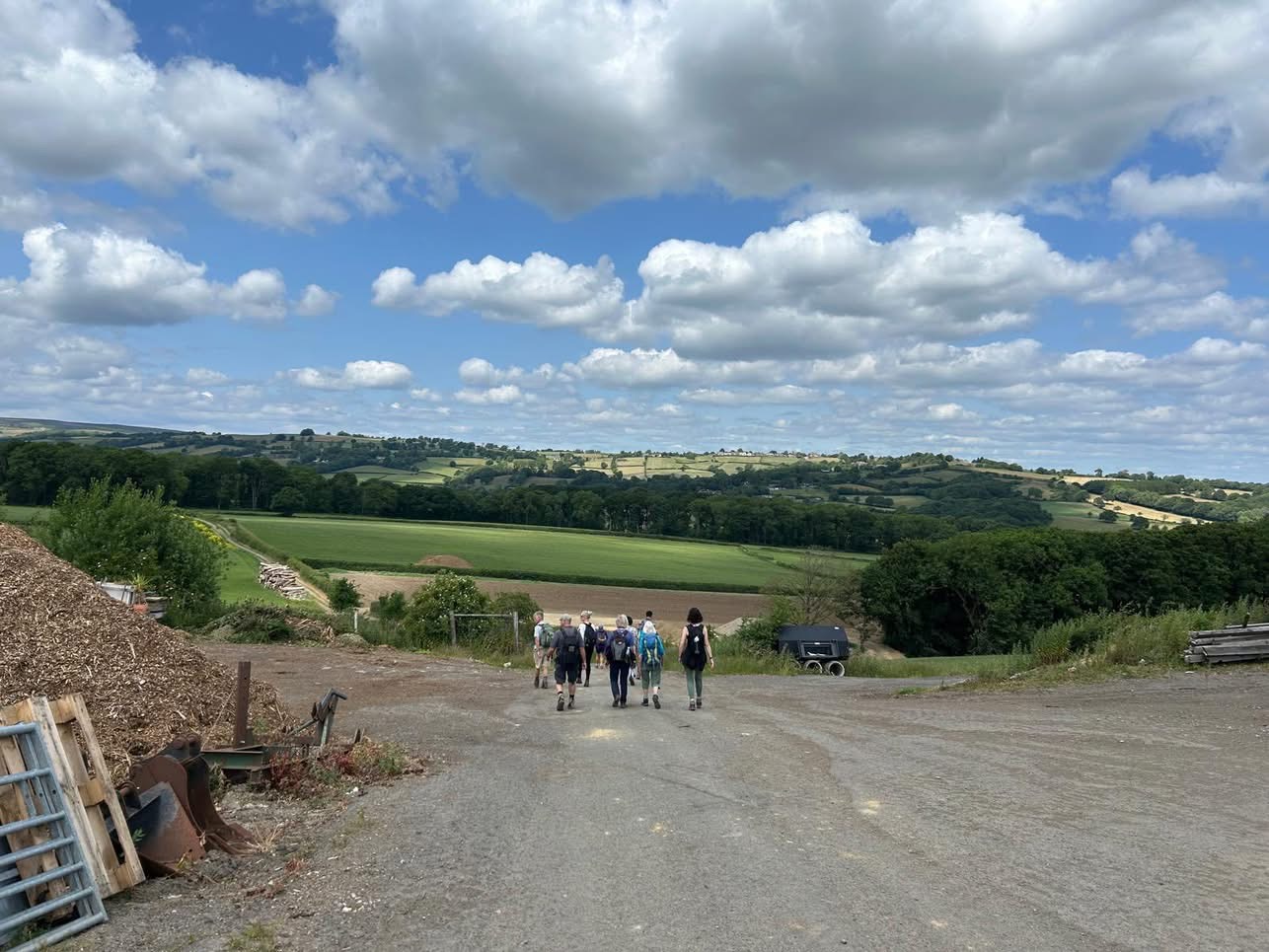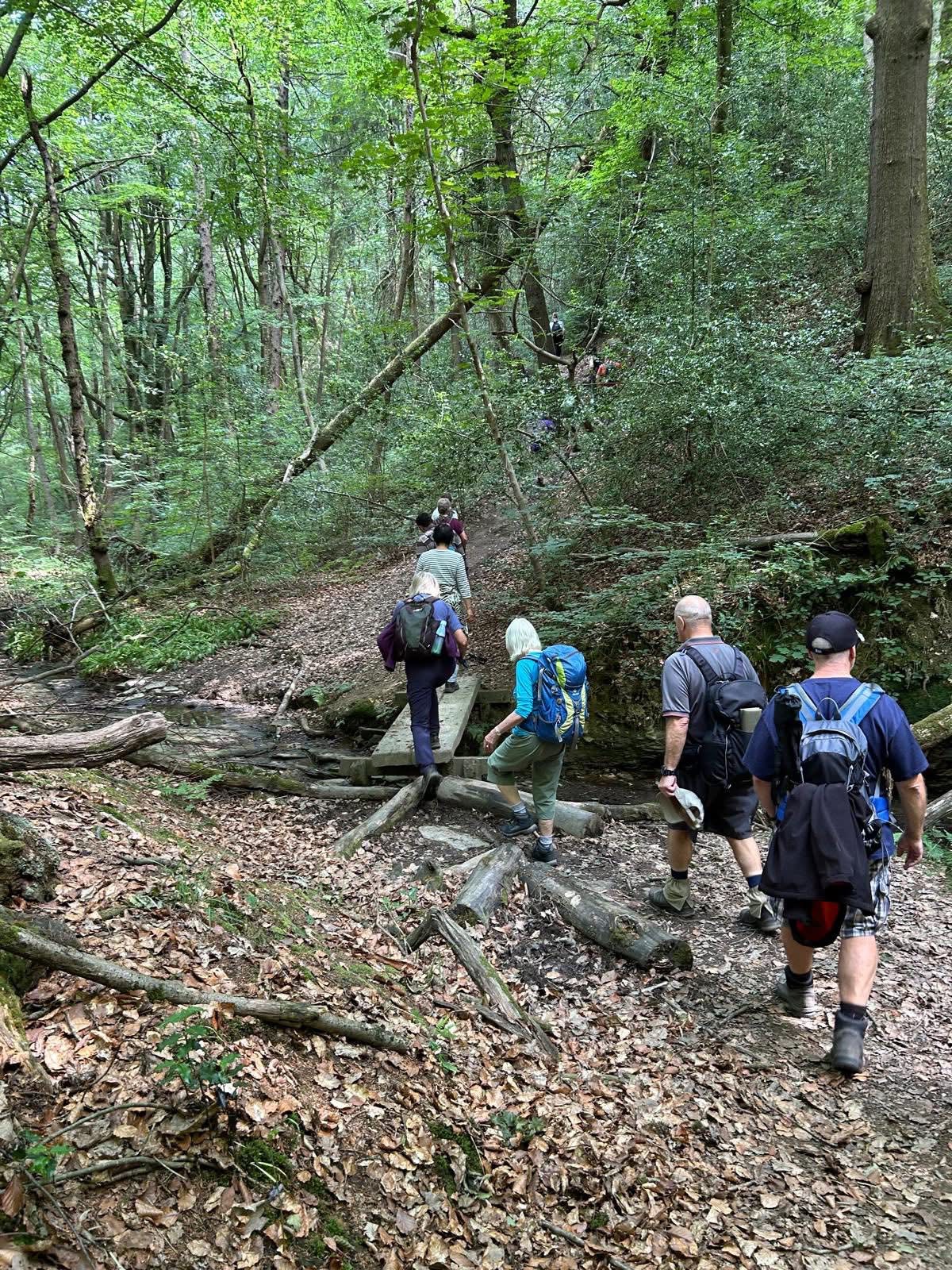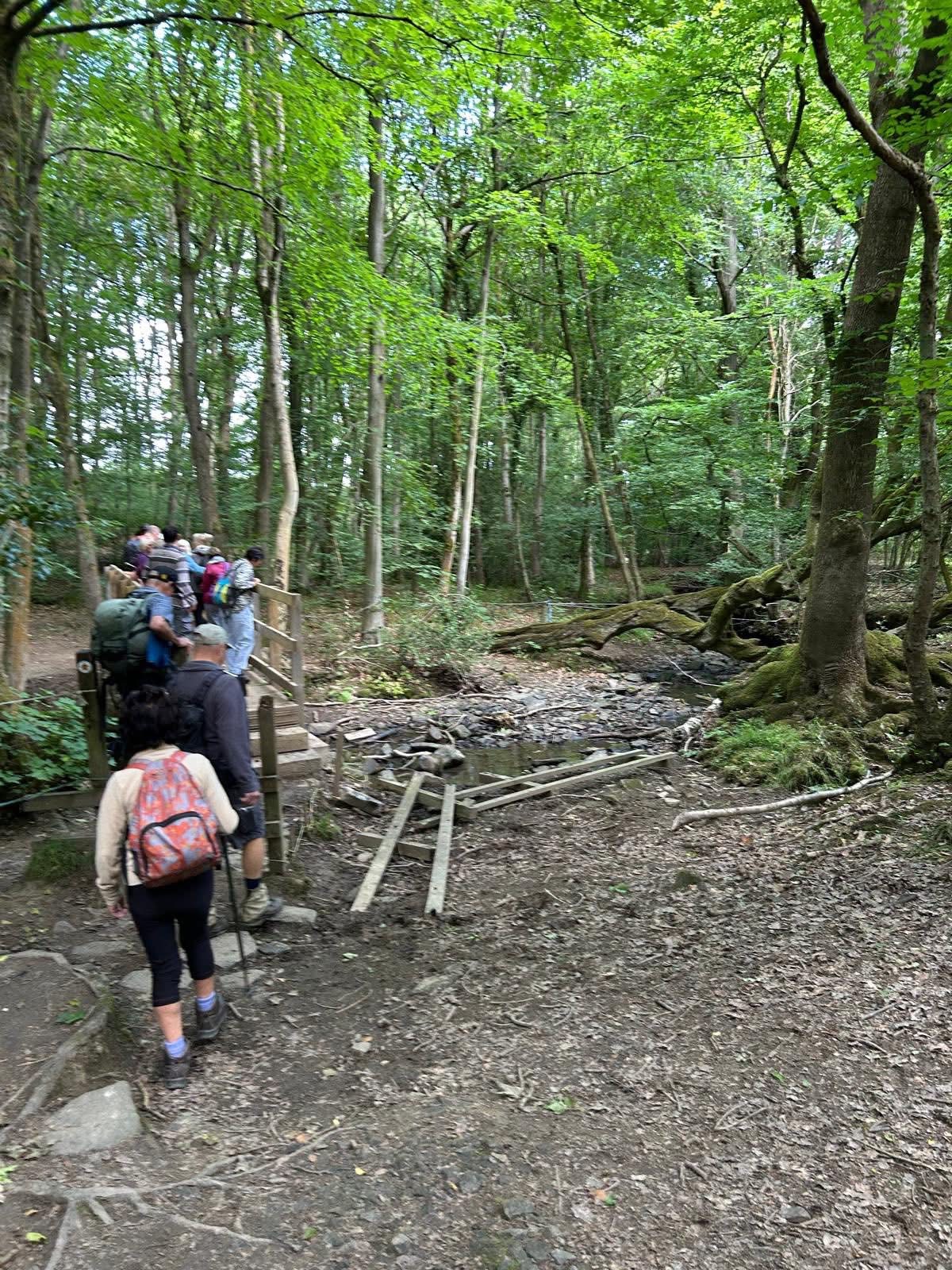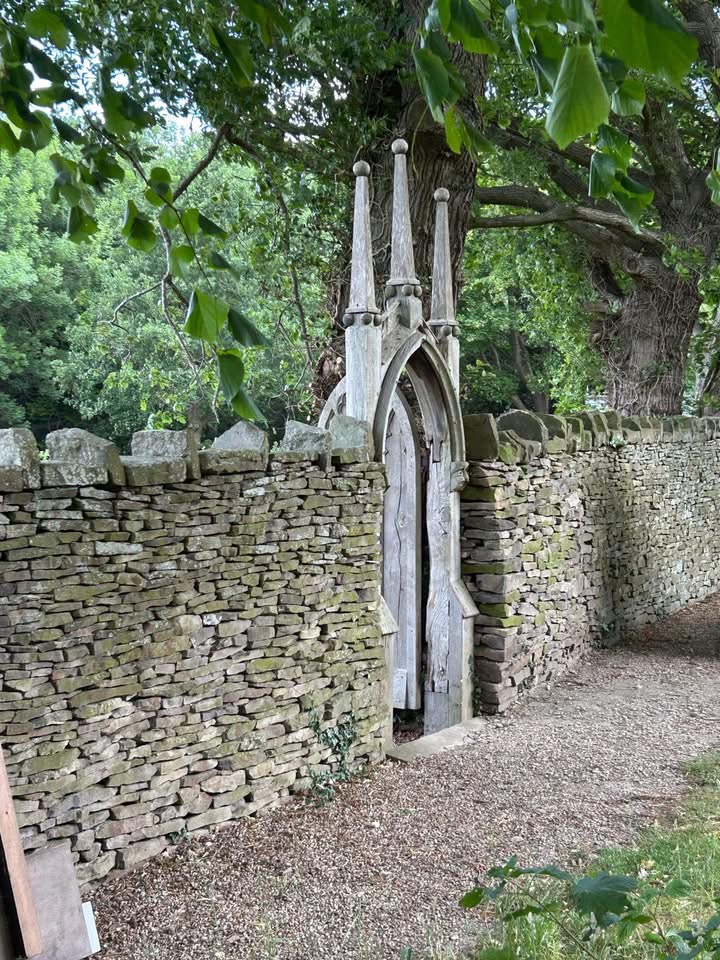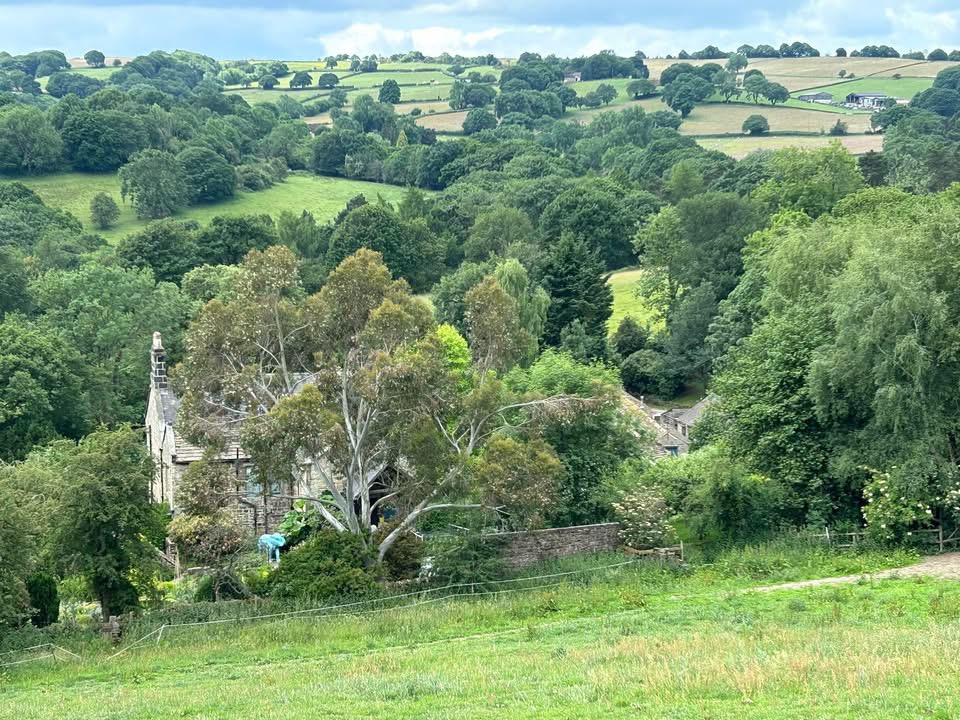
Many thanks to the 18 walkers including two new to the group on a busy Fathers Day. This was a historical walk where I did a small talk at each of the six houses, all of which were over 500 years old with some as old as a thousand years. The walk also includes some lovely flower meadows and superb views. We set off from the Holmesfield Village Hall car park and headed down to Woodthorpe Hall and down to Moorwood. The path then took us past Fanshawgate Hall and up the hill for a coffee break, with great views towards Owler Bar. We continued past Horseley Gate Hall and on to Unthank Hall where the farmer allowed the group in to see the tiny piglets which was very kind of them. They have a great online farm shop too. We then continued past Barlow Woodseats Hall that has great connections to royalty and up to Rumbling Street. The path then went down to Millthorpe and over the ford followed by a climb to Cartledge. Cartledge hall is another beautiful house. We then continued up the hill back to Holmesfield and a welcome rehydration in the George and Dragon. Thanks to Julie for back marking and keeping an eye on me and the rest for all your support.
Six halls walk from Holmesfield.
Talk notes.
Woodthorpe hall, originally built 1540 but probably has a much earlier medieval core back to the 1400s, with later 17th, 18th and 19th century additions. Its a cruck house ( very large curved beams supporting the main structure) and still has working cider press. All the of hall, and some outbuildings are g2 listed . The gatehouse of the hall came from Owlerton Hall which no longer exists and was demolished in 1931, but it was built in 1534 so the gatehouse is contemporary to Woodthorpe hall.
The gateposts came from Derwent Hall, b 1672, the one that was demolished to creat ladybower reservoir in 1944. Some of the building material came from Fanshaw gate hall during its many upgrades and we will see that house later in the walk. A fine 16c fireplace in the dining room originally came from Haddon hall when they refurbished some rooms. Also some of the lower rooms still have 17c wood paneling. Now a prestigious Wedding venue.
https://www.facebook.com/WoodthorpeGardenEvents/?locale=en_GB
Fanshaw gate hall. G2
Fanshaw family records in Holmesfield go back to 1375 but could be earlier.
Original hall building 1456, but records go back to norman times, 1066, which also means that it was there before it was recorded by the normans and was probably a large farm or manor.
Most of present buildings are about 1661.
A dovecott and well in the grounds gates back to 1066. Vaulted norman cellar. The buildings were reduced in size in 1636 and lowered by a story in 1825.
The Fanshaw family died out in 1944, present owners the
Ramsdens occasionally open the gardens to the public.
Gate appears in the names of many historic houses as its old term for a road.
Horseley gate hall. G2
Built originally in 1540, 1783 ext 1856.
Occ opens gardens to public.
Wilsons of sharrow snuff millers once owned it, that family business was established in the 1700s. The snuff mill was originally a water mill and in 1897 upgraded to steam power. Its still in sharrow and still in business and now powered by electric. Snuff was popular with miners and millers. There were many famous writers and victorian celebrities who enjoyed time here
https://www.horsleygatehall.co.uk/history-of-the-house/
Unthank hall. G2* listed.
First recorded 1564. Later additions. It still contains c1700 decorative plasterwork, and decorative friezes. It has been the home of the Lowe family since the 1700s.
Barn is cruck barn and is still in use and is renowned local meats producer. It has a superb website offering local produce.
https://www.unthank-meat.co.uk/
Barlow woodseats hall
Wedding venue and accommodation.
It was originally thatched with a crucked roof and there was a manor house here from 1088. .
Owned by various people including Bess (elizabeth) of hardwick. She was born at Ault Hucknall near where Hardwick Hall is now, her marriages made her very rich and influential. Probably richer than Elizabeth 1st.
Bess was first married at 16 ( ish) to Robert Barlow who owned this house after his father died, he died in 1544 when he was only 14 years old, the first of her 4 husbands. She eventually inherited all the land and property after a court case where the rest of his family contested the will. Her next husbands were sir William Cavendish, sir William St Loe ( captain of the yeomen of the guard and member of parliament for all of Derbyshire ) and then George Talbot, the Earl of Shrewsbury who was tasked with imprisoning Mary Queen of Scots. Cavendish made all his money at the court of augmentation. Henry 8th set this court up to sell on monastery assets to bolster his coffers, him and a few others obviously. Bess persuaded him to sell to her all of the southern holdings so he could buy the land at Chatsworth luckily for us. The Dukes of Devonshire were descended from her second child from her marriage. (Her first child didn't inherit because he was cut out of her will because of his ' friendship' to mary queen of scots).
The Dukeries in Nottinghamshire were named after her other children, the Dukes of Norfolk, Portland, Kingston and Newcastle, they owned the estates at Welbeck, Clumber, Worksop and Thorsby. A real family dynasty all originating from this house.
The main house at Barlow Woodseats was built 1640, at that time the Barley family were tenants appointed as lord of the manor by bess. It has then had various owners from the family of Bess and thier descendants, the Earl of Shrewsbury, then the Earl of Newcastle purchased it in the reign of James the 1st (he also owned Clumber and Welbeck), it was passed by decent to the Duke of Portland (also also owned clumber and welbeck), in 1813 to the Duke of Rutland owned it (of Belvior Castle and Haddon Hall ). In 1843 it passed to Thorold family that can be traced back to Edward the Confessor. All decendants of Bess of Hardwick.
The present owners have been there since 2006 and is now an events and wedding venue.
https://www.barlowwoodseatshall.com/weddings
Cartledge Hall g2*
Another tudor timber framed house dated 1540, although buildings were there in 1452 and recorded as the family home of the Wolstenholmes. It was extended in 17th century.
The entrance hall has a 1620 decorative plaster ceiling taken from Greenhill Hall Sheffield the family of which helped make Canada part of the British empire. Greenhill hall was built in 1340, the last remnants of which were demolished in 1965 by the sheffield council vandals and is now the Sheffield works dept land.
Cartledge hall has lots of period wooden panelling and provision for a very rare water clock ( a tapered pot that water used to drip out of to measure time, one of the earliest forms of a clock ). The south west room has more c1600s plasterwork and a decorative frieze about the fall of man allegedly from Attercliffe Hall which was demolished and the location of which isn't accurately known. The frieze has an inscribed warning ".Whatsoever thou dost take/in hande thinke of the ende and seldom shalt thou ofend" ,figure that one ?
Cartledge hall was renovated by the Doncaster family after the second world war and is a privately owned home today.
https://her.derbyshire.gov.uk/Monument/MDR5178